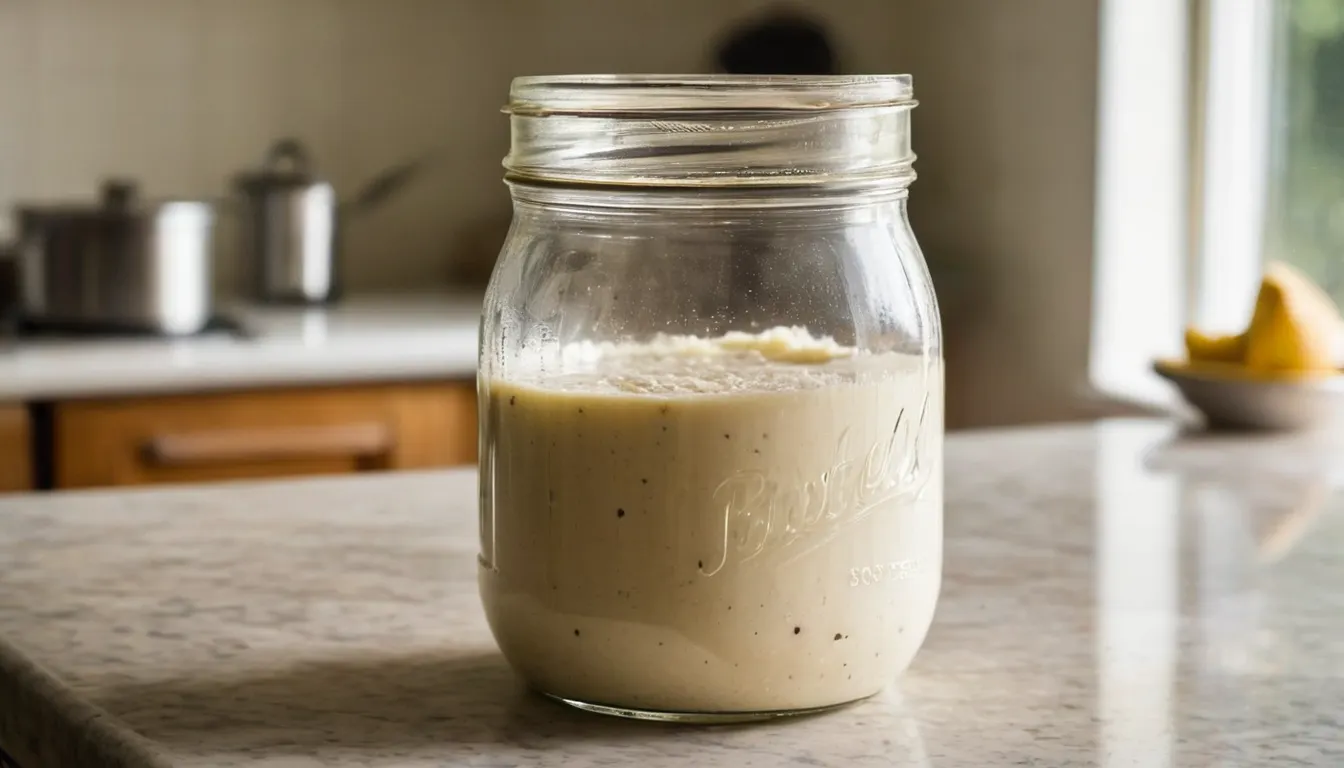
What you need to make a starter
Starter at a glance
- Flour
- Whole wheat or rye to begin
- Water
- Lukewarm, unchlorinated
- Ideal temperature
- 24-27°C / 75-80°F
- Time to ready
- 7-14 days
- Daily cost
- 50 g flour, 50 g water
- Flour: start with wholegrain rye or whole wheat. The bran carries more of the wild microbes and nutrients that get fermentation going. You can switch to white flour later.
- Water: tap water is usually fine. If your supply is heavily treated, use filtered water. Chlorine dissipates if water stands uncovered overnight; chloramine does not, so filter it.
- A clean jar of about 500 ml to 1 litre, a loose lid or cloth, a scale and a spoon or spatula.
- A warm spot. Warmth matters more than anything else. Near a warm appliance (not on it) often works.
Day-by-day sourdough starter schedule
- Day 1. Mix 50 g wholegrain flour with 50 g water at about 27°C (80°F) into a thick paste. Scrape down the sides, put a rubber band at the level of the paste, cover loosely and leave somewhere warm.
- Day 2. You may see bubbles or no change. Either is normal. Stir, and leave it alone.
- Day 3. Keep 50 g of the mixture and discard the rest. Add 50 g flour and 50 g water, mix and mark the level again. This is a 1:1:1 feed: one part starter, one part flour, one part water by weight.
- Days 4 to 5. Activity often drops or stops completely, because the early bubbles came mostly from bacteria that die off as the mixture becomes more acidic. Keep feeding once a day. This is the stage where most people give up too soon.
- Days 6 to 7. Yeast activity starts to show: a domed surface, a sour, yoghurty or beery smell and a rise above your band. Once it rises reliably, feed twice a day, about 12 hours apart.
- Days 7 to 14. Keep up twice-daily feeds. You can now feed with white bread flour or a mix. The starter is ready when it at least doubles within 4 to 8 hours of a feed, three days in a row.
A cool kitchen slows everything down. At 20°C (68°F) a starter can take two to three weeks. Warmer water and a warmer spot are the most effective fixes.
How to tell when your starter is ready
- It at least doubles in volume within 4 to 8 hours of feeding, consistently.
- It has a domed or slightly cracked top at its peak, with bubbles throughout when you look through the glass.
- It smells pleasantly sour, like yoghurt, apples or mild vinegar. A smell of nail polish remover or rot means something is off.
- It feels airy and holds its shape when you lift some with a spoon.
The float test (dropping a spoonful in water) is popular but unreliable, especially for wholegrain or very wet starters. Rise and timing are better guides.
Starter smells, hooch and mould
| You see or smell | What it usually means | What to do |
|---|---|---|
| Grey or brown liquid on top ("hooch") | Hungry starter; alcohol from fermentation | Pour off or stir in, then feed. Feed more often. |
| Acetone or nail polish smell | Very hungry, very acidic | Feed at a larger ratio, such as 1:2:2 |
| Cheesy or sock-like smell in the first week | Early bacteria, normal at this stage | Keep feeding; it usually passes |
| Fuzzy mould, or pink, orange or red streaks | Contamination | Throw it all out, wash the jar and start again |
Mould or pink and orange colours mean the whole starter goes in the bin, jar contents and all. Scraping off the top and carrying on isn't safe. Wash the jar in hot soapy water before you start again.
Next steps
Once your starter passes the readiness test, move on to the feeding and maintenance guide to set up a routine, then bake your first country loaf. From now on, keep a little starter in the fridge as a backup.
Sourdough starter FAQ
Why did my starter stop bubbling on day 4?
That's normal. The first bubbles come mostly from bacteria that die off as the mixture turns more acidic, and activity often drops on days 4 and 5. Keep feeding once a day and yeast activity usually shows by days 6 to 7.
Can I make a starter with white flour?
Wholegrain rye or whole wheat gets fermentation going more reliably, because the bran carries more wild microbes and nutrients. Once the starter rises reliably you can switch to white bread flour or a mix.
How long does a sourdough starter take to be ready?
Usually 7 to 14 days at 24 to 27°C (75 to 80°F). In a cool kitchen at about 20°C (68°F) it can take two to three weeks. It's ready when it at least doubles within 4 to 8 hours of a feed, three days in a row.
Is the float test reliable?
Not very, especially for wholegrain or very wet starters. Rise and timing after a feed are better guides.